









What Remains in the Room: Amalia Mesa-Bains
Amalia Mesa-Bains’ installation art exists in a space between memory and architecture. Working with domestic interiors, altar forms, and material excess, her practice transforms personal and collective histories into immersive environments that resist erasure. Rooted in Chicana feminist thought yet expansive in form, her installations do not offer explanation, but offer presence.
Walking into one of her installations doesn’t feel like entering an exhibition. It feels closer to entering someone else’s interior world, a room that already captures your presence.

Mesa-Bains doesn’t treat memory as something fixed or archival. In her work, memory is built. It takes shape through repetition, material, and proximity. Installations unfold slowly, like rooms shaped over time rather than designed all at once.
Draped textiles soften architectural lines. Objects gather in clusters, never overly arranged. Mirrors interrupt your sense of distance, pulling you closer, then pushing you back again. These spaces feel lived in and are marked by ritual, habit, and quiet devotion. Memory, here, doesn’t move forward. It circles.

Vanities, tables, chairs and mirrors, inviting the domestic to appear again and again. Spaces historically coded as decorative or secondary become central. The vanity, in particular, feels loaded: a place of preparation, self-observation, and pause.

Mesa-Bains reclaims these interiors without sanitizing them. Ornament isn’t treated as excess; it’s treated as evidence. Lace, petals, glitter, and fabric carry personal and cultural histories that refuse minimalism or restraint. Against dominant ideas of “good taste,” these materials insist on staying visible.
Beauty, in this context, isn’t soft. It’s deliberate.

Drawing from altar and ofrenda traditions, Mesa-Bains translates communal spiritual practices into contemporary installation art without stripping them of intimacy. Photographs sit beside devotional objects. Candles burn near film stills and personal mementos. Nothing competes, and nothing is ranked.
In her ofrenda installations, remembrance isn’t frozen in time. Offerings spill outward. Petals land on the floor. The space feels suspended. These works don’t memorialize history so much as keep it active, present, and unresolved.

She describes her approach to space through the idea of "Domesticana"- a way of working that centers feminine, domestic, and often-dismissed forms of knowledge. Through accumulation and ornament, her installations push back against patriarchal and Eurocentric frameworks that have historically defined what counts as serious art.

Materials considered informal or excessive are treated as critical. Found objects, devotional imagery, and personal archives operate as counter-histories, quietly asserting the value of experiences that rarely make it into official narratives. The work feels intimate, but it never feels small.
Mirrors appear throughout Mesa-Bains’ installation art, but they rarely behave as passive surfaces. They invite participation, sometimes gently, sometimes uncomfortably. As you look, you catch yourself layered with images of women from different histories: religious figures, cultural icons and familial presences.

Reflection becomes confrontation. Identity feels less stable, more inherited, more negotiated. You’re no longer observing the work from a distance. You’re inside it, implicated in its questions.
Healing, here, is spatial. It happens through looking.
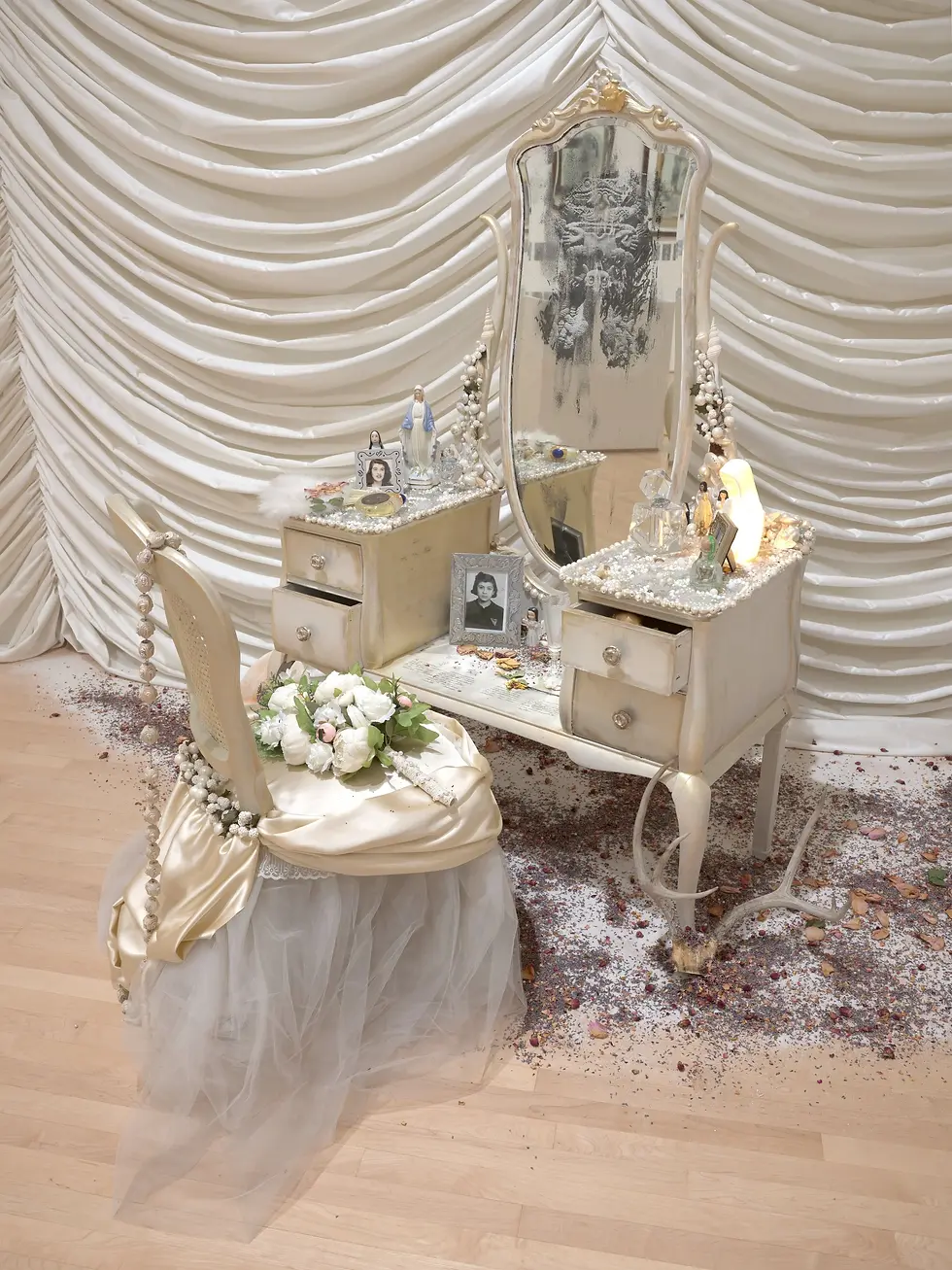
Over decades, Mesa-Bains has expanded what installation art can hold. Her environments function as counter-memories, resisting erasure by centering domestic life, spirituality, and feminine experience. Personal history and collective memory overlap without hierarchy.
Even when shown in museums and institutional spaces, the work retains its intimacy. These installations suggest that memory, once materialized, becomes a form of knowledge and not something to preserve behind glass, but something to activate.

Amalia Mesa-Bains’ installation art lingers because it avoids resolution. It accepts fragmentation. It allows history to remain incomplete. Meaning survives through objects, through space, through small acts of care repeated over time.
You leave her rooms more attentive to interiors, to materials, to what has been placed quietly and left unexplained.
What remains isn’t an image.It’s a sensation.
That memory, once given space, doesn’t disappear.
It waits.


Comments