


Jane Rosen: Seeing Through Touch
Jane Rosen possesses a distinctive ability to evoke both mystery and precision through her work. The animals she chooses, both wild and domesticated, become a means of exploring their instincts and innate intelligence. Rosen believes that understanding animal nature is essential to understanding human nature. Much of her work captures a moment in which an animal is engaged in looking or acting, suggesting a sense of intent while raising questions about the extent to which these beings are conscious of themselves and their own behaviour. Her work delicately and thoughtfully invites us to consider these questions.


Rosen is widely recognised for her ability to reveal the captivating qualities of her subjects. Her work occupies a transitional realm, a space that is at once familiar and ambiguous, between awareness and unawareness, observation and sensation. It is a powerful body of work that brings human experience into dialogue with the natural world, connecting us to something greater than ourselves. Drawing inspiration from a range of sources, including Morandi, da Vinci, ancient Chinese calligraphy, and Egyptian funerary art, Rosen creates sculptures in polished stone and glass that reflect the rich textures and hues of the landscape. Her sculptures honour the profound connection between the animal and human worlds, evoking a sense of serenity, resilience, and timelessness.

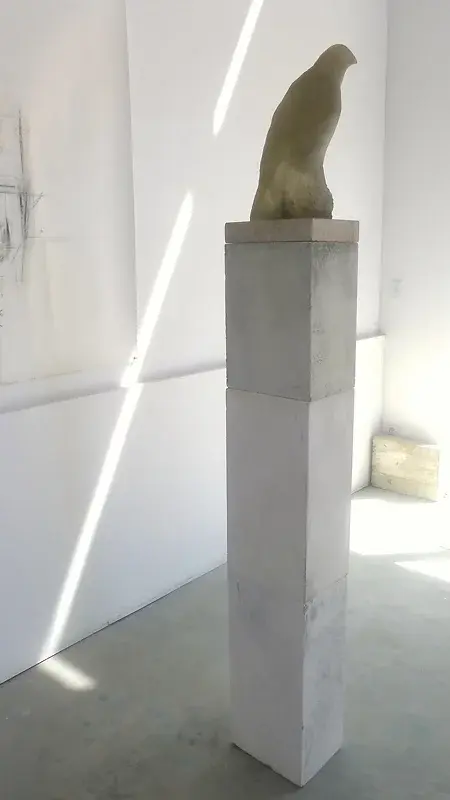
Rosen is particularly drawn to cultures such as those of the Inuit, Native American peoples, and ancient Egyptians, for whom art emerged from an exploration of existence and death rather than from a pursuit of beauty alone. She also looks to these traditions, alongside Renaissance masters such as Michelangelo and da Vinci, as sources of inspiration. Like these artists, Rosen works across multiple mediums, including sculpture, painting, and drawing. Elements of all three are often present within a single work: a closer inspection of a sculpture may reveal traces of paint, while a drawing might feature multiple layers of wax built up across its surface.

Born and raised in New York City, Rosen began her artistic journey there. Despite achieving early success in galleries and establishing herself as a respected teacher in the city, she became increasingly drawn to the accessibility of nature following a trip to the West Coast.

Since the mid-1970s, Rosen's work has appeared in numerous solo and group exhibitions across the United States. Her work has been presented at institutions and galleries including the National Museum of Wildlife Art, the Maier Museum of Art at Randolph College, Edward Thorp Gallery, Grace Borgenicht Gallery, Mincher-Wilcox Gallery, Tayloe Piggott Gallery, Sears-Peyton Gallery, Traver Gallery, Gail Severn Gallery, and MoMA PS1. Her work was also selected by the American Academy of Arts and Letters for inclusion in its Annual Invitational exhibitions in New York in 2010 and 2015.

Rosen has taught at a number of institutions, including the School of Visual Arts in New York (1978–1989), the Maryland Institute College of Art (1985), the University of California, Davis (1990–1992), Stanford University (1993), Bard College (1995–1996), LaCoste School of the Arts (1998), and the University of California, Berkeley (1994–1995 and 1996–2005).
She approaches her role as an educator and mentor with great care, and many of her students have gone on to establish successful artistic careers of their own. At the centre of Rosen's teaching practice is the relationship between the tactile and the visual, a method she calls Seeing through Touch. Developed in part from the teachings of her drawing instructor, Robert Beverly Hale, author of Drawing Lessons from the Great Masters, her approach combines principles of Renaissance drawing with elements of Asian calligraphy. It explores the relationship between what the body senses and what the eye perceives.


Rosen believes that connecting the sensation of touch with the act of seeing can awaken a sense of wonder and discovery in the drawing process. Her method encourages close observation of nature, translating sensory experience into line and allowing the act of drawing to become a means of understanding the world through both sight and touch.


Comments